How Do You Get Rid of Stubborn Belly Fat?
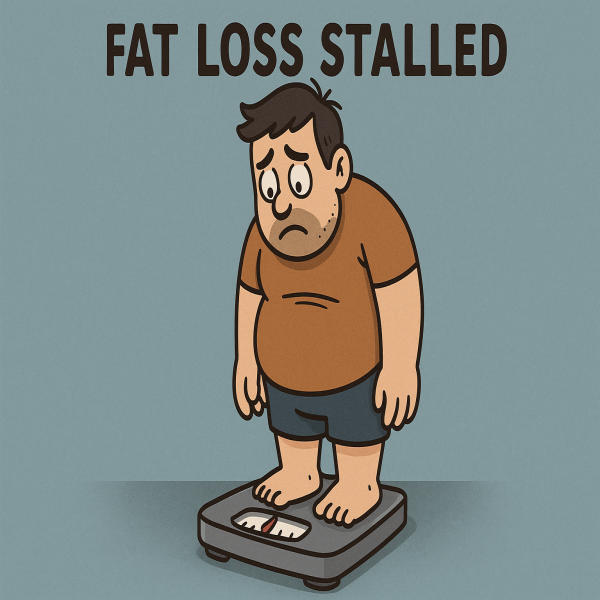
Why Your Fat Loss Stalled: Leptin and the Power of Refeed Days
Anyone who has dieted for an extended period has experienced "hitting the wall": the dreaded slowing, and even complete stoppage, of fat loss.
This is leptin.
Just as noticeable is the increase in appetite that comes with it, often showing up as true, almost uncontrollable cravings for food.
This is also leptin.
Then there is the increased loss of muscle. And the susceptibility to illness. And the fatigue.
Yep. That is leptin too.
It might be time to school yourself on this one hormone.
Fat Loss Starts Fast, Then Stalls
Fat loss is normally rapid at the start of a diet, with up to 1 kilo a week being common, even for someone who is already fairly lean. But that exciting start soon falls victim to the wonderful world of evolution. In times of scarcity, your body is a smart cookie.
If you starve yourself long enough and your body had a voice, this is what it would say:
"We are not getting many calories. I had better slow down how many calories I burn, or the fire will go out."
This is not a random idea. It is backed by science. Low leptin levels are correlated with decreases in resting energy expenditure [6][7][8], and studies that experiment with leptin in animals that have defects in leptin production back this up clearly [9].
What the Research Says About Leptin and Metabolism
Key findings from the study referenced here [9]:
- Energy Expenditure Increase: Leptin increased oxygen consumption in rats by the 4th to 6th day of treatment.
- Increased Metabolic Rate: Leptin increased UCP1 mRNA levels by more than two-fold in brown adipose tissue (BAT), which suggests this contributes to the higher metabolic rate.
- Mechanism: The findings suggest leptin stimulates BAT thermogenesis, contributing to the regulation of energy expenditure in rodents.
- Context: This helps explain how leptin acts as a key signalling molecule for regulating energy balance and fat metabolism.
Low Leptin Makes You Ravenous
Decreases in leptin are strongly associated with increased voluntary food intake in animals, and with hunger and the desire to eat in humans. The research found this hunger response happens regardless of changes in fat stores and food intake [10][11]. And the lower leptin goes, the greater the hunger.
In other words, this is not just a matter of willpower. It is a PHYSIOLOGICAL STARVATION RESPONSE, shaped by millions of years of evolution in a world without supermarkets. It is your body commanding you to find food, right now.
The Vicious Circle Most Dieters Fall Into
It has long been common practice, when low leptin symptoms start to appear, for the dieter (hopefully not you) to cut calories even further, add more cardio, start munching on carrots, or all of the above, to create a larger deficit and force fat loss back on track. This might work for a very short period, but it also drives leptin even lower, making things worse.
At this point the dieter usually does one of two things:
- They repeat the steps above, creating a vicious circle that eventually leads to an inability to drop body fat no matter how low calories go.
- They give up on dieting altogether and tell everyone they cannot lose weight no matter what they try.
But hope is not lost.
The Fix Sounds Crazy: Eat More
What I am about to suggest sounds absolutely crazy and, at first, makes no sense. To keep fat loss going, the dieter needs to eat MORE, not less, for a short amount of time.
I do not mean a slice of pizza or eating at maintenance for a day. I am talking about what is essentially pigging out for 12 to 48 hours. And to top it off, most of those calories will come from the evil "carbohydrate".
Refeeds, Not Cheat Days
I do not like the term "cheat day", because it implies you are doing something wrong. What I am describing are REFEED days. They are PURPOSEFUL and they are PLANNED. That is why we call them refeeds. "Cheat days" just make you feel bad, and that is not a healthy choice of words for self-love.
Refeeds are ideally done on a regular basis, BEFORE all of the low leptin symptoms set in. Deliberate, planned overfeeding on carbohydrates is the lever that pulls leptin back up.
Are You Overdue for a Refeed?
If you have been stuck in a dieting rut for a while, run through this quick questionnaire:
- Are you eating at a normal calorie deficit for your body and routine?
- Have you lost any body fat in the last 4 weeks?
- Have you taken a serious break from dieting or a calorie deficit in the last 10 weeks?
- Do you eat plenty of carbohydrates? (This does not apply to keto followers.)
- Do you have a planned day of eating more carbohydrates to stimulate your metabolism?
If your honest answers point to a long, unbroken deficit with no planned high carb days and stalled fat loss, a planned refeed is very likely the lever you are missing.
Key Takeaways
- ✓Leptin is the hormone that tells your body how many calories to burn; a long diet pushes it down and fat loss stalls.
- ✓Low leptin also drives intense hunger and cravings: it is a physiological starvation response, not weak willpower.
- ✓Cutting calories even further when you stall lowers leptin more and creates a vicious circle.
- ✓A planned refeed of 12 to 48 hours, mostly carbohydrates, raises leptin and can restart fat loss.
- ✓Refeeds are planned and purposeful, ideally done before symptoms set in: they are not cheat days.
References
- [1]Halaas JL, Boozer C, Blair-West J, Fidahusein N, Denton DA, Friedman JM. Physiological response to long-term peripheral and central leptin infusion in lean and obese mice. Proc Natl Acad Sci U S A 1997 Aug 5;94(16):8878-83
- [2]Spiegelman BM, Flier JS. Adipogenesis and obesity: rounding out the big picture. Cell 1996 Nov 1;87(3):377-89
- [3]Maffei M, Halaas J, Ravussin E, Pratley RE, Lee GH, Zhang Y, Fei H, Kim S, Lallone R, Ranganathan S, et al. Leptin levels in human and rodent: measurement of plasma leptin and ob RNA in obese and weight-reduced subjects. Nat Med 1995 Nov;1(11):1155-61
- [4]Frederich RC, Hamann A, Anderson S, Lollmann B, Lowell BB, Flier JS. Leptin levels reflect body lipid content in mice: evidence for diet-induced resistance to leptin action. Nat Med 1995 Dec;1(12):1311-4
- [5]Unger RH. Leptin physiology: a second look. Regul Pept 2000 Aug 25;92(1-3):87-95
- [6]Doring H, Schwarzer K, Nuesslein-Hildesheim B, Schmidt I. Leptin selectively increases energy expenditure of food-restricted lean mice. Int J Obes Relat Metab Disord 1998 Feb;22(2):83-8
- [7]Pelleymounter MA, Cullen MJ, Baker MB, Hecht R, Winters D, Boone T, Collins F. Effects of the obese gene product on body weight regulation in ob/ob mice. Science 1995 Jul 28;269(5223):540-3
- [8]Doucet E, St Pierre S, Almeras N, Mauriege P, Richard D, Tremblay A. Changes in energy expenditure and substrate oxidation resulting from weight loss in obese men and women: is there an important contribution of leptin? J Clin Endocrinol Metab 2000 Apr;85(4):1550-6
- [9]Scarpace PJ, Matheny M, Pollock BH, Tumer N. Leptin increases uncoupling protein expression and energy expenditure. Am J Physiol 1997 Jul;273(1 Pt 1):E226-30
- [10]Brunner L, Nick HP, Cumin F, et al. Leptin is a physiologically important regulator of food intake. Int J Obes Relat Metab Disord 1997;21:1152-60
- [11]Keim NL, Stern JS, Havel PJ. Relation between circulating leptin concentrations and appetite during a prolonged, moderate energy deficit in women. Am J Clin Nutr 1998 Oct;68(4):794-801
- [12]Campfield LA, Smith FJ, Guisez Y, Devos R, Burn P. Recombinant mouse OB protein: evidence for a peripheral signal linking adiposity and central neural networks. Science 1995 Jul 28;269(5223):546-9
- [13]Ruhl CE, Everhart JE. Leptin concentrations in the United States: relations with demographic and anthropometric measures. Am J Clin Nutr 2001 Sep;74(3):295-301
- [14]Resting metabolic rate reference chart adapted from the American College of Sports Medicine (ACSM). Subject age: 20 to 59.